
TL;DR: A vertical toggle clamp is a manually operated workholding device that locks a workpiece down via an over-center linkage. The three specs that determine whether it fits your fixture are holding capacity, base style, and handle orientation. Standard models cover roughly 100 lbs to over 2,000 lbs of holding force. Flanged base for mounting to flat plates, straight base for side-mounting against a wall.
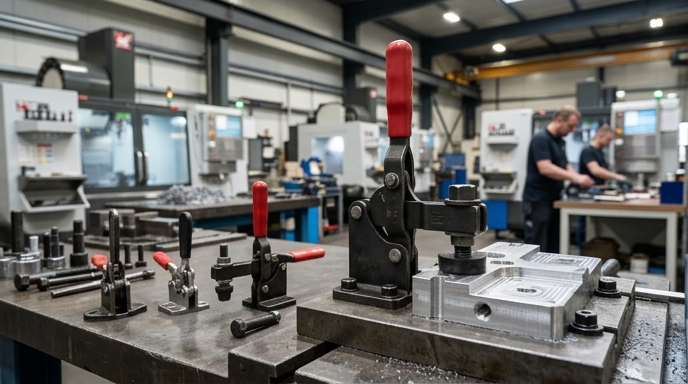
The Three Specs That Actually Determine Fit (Not the Ones on the Label)
Picking a vertical toggle clamp is really about matching the clamp’s geometry to the fixture plate. Most of the time buyers grab whatever catalog page has the biggest “Holding Capacity” number in bold and call it done. That number is usually the least useful spec on the page.
Three variables decide whether a clamp will actually work on a milling or welding fixture:
- Force at the workpiece. The actual downward pressure the spindle applies, which is always lower than the published holding capacity.
- Bolt pattern vs. fixture plate. Standard fixture plates are typically 1/2″ or 5/8″ aluminum or steel, and the clamp’s base has to line up with available T-slots or drilled holes. A Destaco 207-U needs a 1.00″ x 0.88″ (25.4 x 22.4 mm) rectangular hole spacing.
- Handle swing arc clearance. The physical space the operator’s hand needs to push the handle from open to locked without smacking a machine guard or the workpiece itself.
That third one gets ignored constantly, and then the fixture gets built and nobody can actually run it.
Holding Capacity vs. Bar Capacity — Why Your Clamp May Be Undersized
Holding capacity is the static force a locked clamp resists. Bar capacity is the force the arm can take before it visibly deflects. These are not the same number, and the catalog rarely spells that out.
Destaco, Carr Lane, Good Hand — they all publish “Holding Capacity” as the maximum load the clamp can withstand in the locked, over-center position before permanent deformation or mechanical failure. Static rating. The actual “Exerting Force” or “Clamping Force,” the pressure the spindle lays into the part, is typically only 1/3 to 1/2 of that stated holding capacity. So if you spec a 500 lb holding capacity clamp to resist 400 lbs of upward milling force, the U-bar deflects and your part lifts. I’ve seen guys on the machinist forums post photos of exactly this — bent bar, scrapped part, surprised look.
| Model | Published Holding Capacity | Spindle Thread | Base Style |
|---|---|---|---|
| Destaco 201-U | 100 lbs (440 N) | 10-32 | Flanged |
| Destaco 207-U | 375 lbs (1670 N) | 5/16-18 | Flanged |
| Destaco 210-U | 600 lbs (2670 N) | 3/8-16 | Flanged |
| Good Hand GH-22100 | 550 lbs (250 kg) | M8x1.25 | Flanged |
Obviously you wouldn’t spec a 201-U for anything beyond a light drilling jig.
Reading a Capacity Chart Without Getting Burned
Toggle clamps are a lever system, so where the spindle sits on the clamping bar changes the applied force. A lot.
Most vertical toggle clamps use a U-bar design, which lets the operator slide the spindle assembly closer to or further from the handle. Push the spindle out to the far end of the U-bar and you gain reach, but mechanical advantage drops off a cliff. Per the manufacturer derating curves, moving a spindle from the innermost position to the outermost on a standard 3″ U-bar can cut actual clamping force by up to 50%.
Rule of thumb when sizing: calculate the required hold-down force, double it to cover the exerting-force ratio, then tack on another 20% safety margin if the spindle is going to live at the far end of the bar.
Flanged vs. Straight Base — Fixture Geometry Decides
A flanged base mounts from above through a flat flange. A straight base mounts from the side through the clamp body. That’s the whole distinction, and it drives everything else.
The flanged base is the default. Horizontal mounting plate, four slotted holes, bolts straight down onto a fixture plate or benchtop. This is what you’ll see on 90% of installations.
The straight base (denoted by an “S” in the part number, so Destaco 207-S) ditches the horizontal flange. The vertical side plates of the clamp extend down with mounting holes, so the clamp bolts to the side of a vertical fixture wall or drops into a recessed pocket. Saves horizontal footprint, which matters more than people think once a fixture plate starts getting crowded with locating pins, stops, and multiple clamps competing for real estate.
The useful thing is that the major manufacturers all standardize their bolt patterns. A Carr Lane CL-150-VTC or a Good Hand GH-22070 drops right into a hole pattern drilled for a Destaco 207-U. So you can swap brands without re-drilling the fixture, which is handy when your preferred supplier is backordered six weeks and the shop foreman is leaning on your desk.
Handle Direction, Swing Arc, and Operator Ergonomics
Vertical toggle clamps are named for their handle position: when locked, the handle points straight up.
That vertical orientation needs overhead clearance, and the handle swing arc tells you how much. On a Destaco 207-U, the handle opens 62 degrees and the clamping bar opens 115 degrees. If a machine spindle or an overhead gantry sits right above the fixture, the operator physically can’t open the clamp all the way. This is the kind of thing you catch in CAD if you remember to model the handle in its open position, and miss entirely if you don’t.
Ergonomics are the other half of handle selection. OSHA and NIOSH guidance both flag highly repetitive manual tasks as a musculoskeletal disorder risk, and pushing a vertical handle forward requires wrist extension on every cycle. For high-cycle fixtures, newer models like the Destaco 2002-U give you more hand clearance between the bar and the handle, which cuts down on pinch injuries during fast operation.
Spindle Assembly — The Part That Touches the Workpiece
The spindle assembly is the threaded contact point that applies pressure to the workpiece — threaded rod, locking nuts, contact tip.
Thread sizes scale with clamp capacity. A 100 lb clamp uses 10-32. A 375 lb clamp uses 5/16-18. A 600 lb clamp uses 3/8-16.
Tip material matters, and the options are:
- Neoprene tips — standard on most clamps, prevent marring on aluminum, wood, or plastic.
- Swivel feet — steel pads on a ball joint, articulate to sit flat on angled or uneven surfaces.
- Machinable blanks are solid steel or aluminum cylinders you mill to match the contour of a complex part, and this is the option toolmakers reach for when nothing off the shelf will seat properly on a weird casting.
One mistake I see a lot: if the workpiece is unusually tall, don’t just buy a longer spindle. A long spindle becomes a lever against the U-bar and the whole thing deflects. Mount the clamp on a riser block instead, keep the spindle short and rigid.
Material, Plating, and Environmental Fit
Standard vertical toggle clamps are stamped carbon steel with zinc plating. Fine for a dry shop.
For corrosive environments, washdown stations, or food processing, there are stainless variants, usually marked with an “SS” suffix (Destaco 207-USS and so on). Stainless resists chemical degradation but anecdotally runs somewhere in the ballpark of 30-50% more than the carbon steel equivalent — worth pricing out on your actual distributor before you commit.
Temperature ratings come down to the tip. Standard neoprene degrades and melts above 212°F (100°C). For welding fixtures or curing ovens, spec solid steel spindles or high-temperature urethane tips. I still default to solid steel for anything near a weld cell even when urethane would probably survive — old habit from getting burned (literally) on a jig that lived next to a MIG station.
When a Vertical Toggle Clamp Is the Wrong Choice
Manual vertical toggle clamps fail in three specific scenarios.
Inconsistent part heights. Toggle clamps rely on a strict over-center mechanical lock, which gives you a clamping window of just a few thousandths of an inch. If your cast or molded parts vary by more than 0.050″, the clamp will either crush the thick ones or fail to grip the thin ones. Spring-loaded or hydraulic clamps handle variation better.
High-cycle automation. More than 500 actuations per shift and manual clamping becomes an ergonomic liability. Pneumatic toggle clamps like the Destaco 807-U use an air cylinder to drive the same mechanical linkage, which takes the operator out of the equation.
Extreme force requirements. Manual toggle clamps top out around 2,000 to 3,000 lbs of holding capacity. Need 5,000+ lbs of hold-down? That’s hydraulic swing clamp territory.
FAQ
1. What does “holding capacity” actually mean on a toggle clamp spec sheet?
It’s the maximum static load the clamp can withstand in the locked position before it bends or breaks. It is not the amount of downward force the clamp applies to the part — that’s a separate, lower number that almost nobody prints in bold.
2. Are DE-STA-CO toggle clamps interchangeable with generic brands?
Yes. Carr Lane and Good Hand both build to the Destaco 200-series bolt patterns and reach dimensions, so drop-in replacement is realistic.
3. Can I change the handle direction on a vertical toggle clamp after installation?
No. Handle direction is riveted into the linkage. If you need a horizontal handle, buy a horizontal toggle clamp.
4. What size bolt do I need to mount a flanged base vertical toggle clamp?
Depends on the clamp. A 100 lb clamp takes #10 bolts. A 375 lb clamp (the 207-U) takes 1/4″. A 600 lb clamp takes 5/16″.
5. How do I know if my clamp is undersized for the application?
If the U-bar visibly bends upward when you lock the clamp, or if the workpiece chatters and lifts during machining, your exerting force is too low. Move the spindle closer to the handle, or step up to a higher-capacity clamp. If you’re already at the inner spindle position on the biggest manual clamp in the catalog and still seeing lift, you’re outside the manual toggle envelope and need to look at pneumatic or hydraulic alternatives — don’t try to fix it with a longer handle or a cheater bar, which some people absolutely will try.
Author Bio: Written by a manufacturing researcher focused on workholding, fixture design, and CNC machining setups.
