
For production CNC fixturing, De-Sta-Co is still the benchmark. Good Hand gets you roughly 70% of the performance at about half the price, which is a serious consideration for anyone speccing a job-shop fixture that’ll see 500 cycles and then live on a shelf. Bessey owns the hobbyist and light-industrial woodworking end. The biggest real-world differentiator across all five brands isn’t holding force or price. It’s country of origin and what that means for your spare parts pipeline six months after you install the fixture.
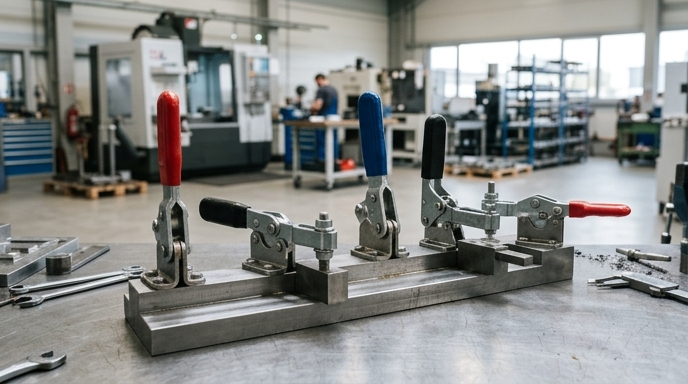
How We Ranked These Five Brands
The criteria here are the ones that actually matter on the shop floor, not the ones that look good on a spec sheet. Build quality and whether the published holding capacity holds up under a real production run. Spare parts availability, which is the single thing nobody thinks about until a spindle bends on a Tuesday morning. Price per clamp class, because the industrial tiers and the consumer tiers are not really competing with each other, no matter what the search results suggest.
Manufacturing transparency and warranty terms factor in too. De-Sta-Co and Bessey both run a standard 1-year warranty from date of shipment, which is pretty typical for the category.
Spare parts lead times got weighted heavily. A $15 savings on a clamp is irrelevant when a broken pivot pin halts a $150/hour CNC machine for three days.
De-Sta-Co — The Benchmark Everyone Else Is Measured Against
De-Sta-Co is the Michigan-founded workholding manufacturer that originated the modern over-center toggle clamp. Originally the Detroit Stamping Company, founded in 1915, the brand is still the default spec in automotive and aerospace fixturing. In April 2024, Stabilus acquired De-Sta-Co from Dover Corporation for $680 million. Whether that changes anything about the product line over the next few years is anyone’s guess; acquisitions in this space usually don’t move the needle on the catalog for at least 18 months.
The red-handled manual clamps are the industry’s reference geometry. The 200-series horizontal hold-downs are the most-copied designs on the planet, full stop. A 207-U gives you a 375 lb holding capacity and runs somewhere in the $28 to $35 range depending on distributor. If you’re speccing clamps for an aerospace OEM-approved fixture, you default to De-Sta-Co. The material traceability is documented, the cyclic fatigue behavior is predictable, and your auditor has seen the paperwork before. That matters more than any price comparison.
Carr Lane — The Engineering-First American Alternative
Carr Lane is who you call when the fixture designer wants real engineering support and a modular ecosystem instead of just a clamp in a bag. Headquartered in St. Louis, and the majority of the tooling components are made in the US. They don’t just sell clamps, they sell the whole fixture stack: alignment pins, rest buttons, threaded inserts, the works.
For design engineers, the big thing is that Carr Lane publishes native CAD downloads in STEP, IGES, and Parasolid straight from the online catalog. You don’t model clamps from scratch anymore. You just drop them in.
Common Carr Lane applications:
- Wide-opening vertical clamps for welding fixtures that need clearance
- Push-pull toggle clamps, usually for secondary ops — broaching, tapping, that kind of thing
- Latch-action clamps, which show up on mold halves and pressure vessel work
Jergens — The Heavy-Duty and Pneumatic Specialist
Jergens plays in the power workholding space, with a real focus on pneumatic and hydraulic toggle variants that the other brands kind of under-serve. They’re out of Cleveland, and the big trick with Jergens is that the toggle clamps integrate directly with their proprietary Ball Lock mounting system. Which means you can swap entire fixture plates in seconds and still hold sub-millimeter repeatability, assuming the receivers were installed correctly in the first place — and that’s a big assumption I’ve seen go sideways in shops that rushed the first install.
The pneumatic toggles run on standard 100 PSI shop air. They replace the manual handle with an air cylinder so you can actuate a whole bank of clamps on one fixture off a single manifold valve. For anyone running automated loading, this isn’t optional, it’s the only sane way to do it.
| Actuation Type | Jergens Equivalent Class | Holding Force | Air Requirement |
|---|---|---|---|
| Manual | Standard Vertical | 500 lbs | N/A |
| Pneumatic | Heavy-Duty Air Toggle | 800 lbs | 100 PSI |
| Pneumatic | Compact Air Toggle | 200 lbs | 80 PSI |
Good Hand (GH) — The Taiwan-Made Value Leader
Good Hand is a Taiwan-based manufacturer that OEMs toggle clamps for several Western-branded workholding lines. You’ve probably used GH clamps and not known it. They produce very accurate clones of standard De-Sta-Co footprints, and for shops that don’t need aerospace material certs, they’re the honest high-value pick.
The price delta is real. A GH-201-B gives you a 200 lb holding capacity and typically retails for $10 to $14. The De-Sta-Co equivalent, the 202-U, is roughly twice that. GH clamps are widely stocked by US and EU distributors, so your spare neoprene spindles and flanged washers aren’t a six-week lead time.
Identifying Genuine Good Hand Clamps: Real GH clamps have stamped “GH” model numbers on the baseplate and use hardened steel pivot pins. The mainland China knockoffs you see in multi-packs on Amazon use unhardened mild steel pins, which shear under cyclic fatigue. If you’re pulling a clamp out of a four-pack that cost less than a sandwich, you already know what you’ve got.
Bessey — The Woodworker’s and Light-Industrial Pick
Bessey brings German engineering to the light-industrial and woodworking side. The toggle clamp line is aimed at router templates, drill press tables, and track saw jigs, not production CNC fixtures.
Their big differentiator is the STC Auto-Adjust series. The woodworking forums report the STC mechanism will absorb material thickness variations up to about 5/8″ (16mm) without you having to re-wrench the spindle every time stock changes. The STC-VH50 vertical gives up to 700 lbs of adjustable clamping force, which is more than most people assume given the market Bessey plays in. There’s a set screw in the cantilevered joint that lets you dial in exact pressure, which is the feature that actually matters if you’re clamping softwoods like pine or cedar and you don’t want witness marks on finished faces. I still spec Bessey for shop jigs even when a Good Hand would technically do the job, mostly out of habit — the ergonomics are just nicer.
Head-to-Head Comparison Table
| Brand | Origin | Price Tier | Typical Capacity Range | Pneumatic Options | Spare Parts | Best-Fit Use Case |
|---|---|---|---|---|---|---|
| De-Sta-Co | US/Global | High | 60 – 16,000 lbs | Yes | Excellent | Aerospace/Auto OEM |
| Carr Lane | USA | High | 100 – 10,000 lbs | Yes | Excellent | Custom Fixture Design |
| Jergens | USA | Premium | 200 – 5,000 lbs | Yes | Excellent | Power Workholding |
| Good Hand | Taiwan | Low/Mid | 50 – 10,000 lbs | Limited | Good | High-Value Job Shop |
| Bessey | Germany/Asia | Mid | 500 – 700 lbs | No | Fair | Woodworking/Jigs |
How to Match a Brand to Your Application
Picking a toggle clamp comes down to production volume, cycle count, and total cost of ownership. Anecdotally, the cheap unbranded stuff fails somewhere in the 5,000-to-10,000 cycle range in a real production environment, usually via pivot pin fatigue or the handle just bending out of plane. Your mileage will vary, but not by an order of magnitude.
- Automated actuation: Jergens. The pneumatics drop into PLC-controlled machining centers without drama.
- Aerospace OEM compliance: De-Sta-Co, every time. The material traceability and the fatigue data satisfy ISO 9001 auditors because they’ve seen the paperwork a thousand times before.
- Varying stock thickness on a jig: Bessey. The auto-adjust is a genuine time-saver when you’re swapping between 1/2″ and 5/8″ MDF all afternoon.
- Low-cycle job shop fixture: Good Hand. A $12 GH clamp is absolutely the right call when the fixture is going to see 500 cycles and then get torn down and put on a shelf.
FAQ
What is the best brand of toggle clamp for CNC fixturing?
De-Sta-Co, for production CNC. Predictable holding capacity, massive spare parts network. Carr Lane is a close second if your fixture designer wants native CAD.
Are Good Hand toggle clamps the same as De-Sta-Co?
No, but the mounting footprints are identical and the geometry is close enough that in most job-shop use cases you cannot tell the difference under cycle. Where you can tell the difference is in the paperwork. Good Hand doesn’t carry the same aerospace OEM certifications or the same metallurgical guarantees, and the heat treat specs on the pivot pins aren’t published to the same level of detail. For a non-certified fixture, none of that matters. For a flight-hardware fixture, all of it does. Spec accordingly.
Which toggle clamp brands are actually made in the USA?
Carr Lane and Jergens, for the vast majority of their workholding. De-Sta-Co is mixed — some legacy lines still US-made, others out of Europe and Asia.
How much holding force do I actually need?
Holding capacity is the max load before the clamp permanently deforms. Light woodworking, 200 lbs is plenty. Aggressive steel milling, you want at least 500 to 800 lbs to stay ahead of cutting forces.
Author Bio: The author is a former CNC shop manager and fixture designer with over a decade of experience speccing workholding for 3-axis and 5-axis machining centers.
