
Toggle clamp specifications come down to three decisions: material (carbon steel, stainless, or zinc-plated), size (base footprint plus handle and spindle length), and holding capacity, which runs anywhere from 50 lbs on the mini stuff to well over 7,500 lbs on the forged heavy-duty units. The right spec depends on clamping force, environment, and mounting constraints. Not just the headline capacity number. Match capacity to a 2× safety factor at minimum.
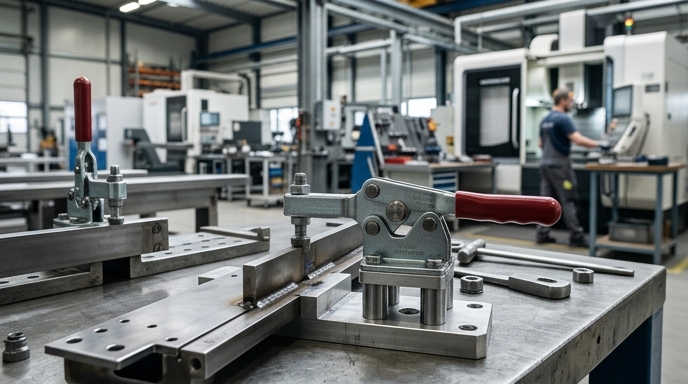
Reading a Toggle Clamp Spec Sheet (What Each Number Actually Means)
Manufacturer datasheets organize specs into mechanical limits and physical dimensions. The number everyone looks at first is Holding Capacity. On a standard horizontal clamp like the Destaco 207-U, the datasheet lists 375 lbs (1670 N). That number is the maximum static load the clamp can withstand in the locked position before it yields or permanently deforms. It is not what the clamp presses down with. More on that in a minute.
Datasheets also spec kinematic movement. The Bar Opening Angle is how far the clamping arm swings back so you can get the part out. On the 207-U, that’s 99°. The Handle Opening Angle is 62° on the same model — this is the arc the operator’s hand travels through, which matters more than people think when you’re building a fixture that lives inside a VMC enclosure.
Finally, Spindle Thread and Mounting Pattern. A 5/16-18 spindle needs matching nuts and tips, and the flanged base dimensions (1.25″ x 1.00″ hole spacing is typical here) set the footprint on your fixture plate.
Material Choices and Where Each One Fails
Three materials cover 95% of what you’ll see: carbon steel (cheapest, dry environments only), stainless (coolant, washdown, outdoor), and zinc-plated steel (middle ground). Pick wrong and the fixture dies early.
Zinc-Plated Carbon Steel. Industry default. Handles shop humidity and the occasional splash. In a CNC with water-soluble coolant pooling on the fixture plate, zinc fails fast — once that plating is gone, the carbon steel underneath pits, rusts, and eventually the pivot pins seize up. I’ve pulled apart clamps that lasted maybe six months in a flood-coolant environment because somebody specced zinc to save a few bucks per unit.
Stainless (304/316). Suffix usually tells you — Destaco 202-USS, that kind of thing. Resists acidic coolants, washdown, outdoor rigs. The failure mode here isn’t corrosion, it’s thread galling. Adjust a stainless spindle dry and the threads can cold-weld. Anti-seize, every time.
Forged Steel and Cast Iron. Heavy-duty units. Forged bars, cast iron bases, meant for impact loads and thermal cycling. In welding, standard zinc-plated clamps die because spatter melts straight into the plating and bonds to it. Copper-plated spindles shed the spatter and forged bases take the heat without complaint.
Size Classes: Mini, Standard, and Heavy-Duty Footprints
Three general classes based on base footprint and thread spec.
Miniature. Electronics assembly, light woodworking. The Destaco 205-U type — 60 lbs (267 N) capacity, roughly 1.00″ x 1.00″ base, #8-32 or M4 spindle.
Standard. Most manual machining and general fixture work. 200 to 600 lbs. A 375 lb unit will typically run a 5/16-18 or M8 spindle on a 1.25″ x 1.00″ flanged base, taking 1/4-20 or M6 socket heads.
Heavy-Duty. Milling, pressing, welding. Starts at 1,000 lbs and goes past 4,000. 1/2-13 or 5/8-11 spindles. Bases are often solid weld-on rather than flanged, or wide bolt patterns needing 3/8″ or M10 hardware.
Holding Capacity vs. Clamping Force — The Spec That Fools Buyers
This is the one. Holding capacity is the static load the locked clamp can resist. Clamping force is the dynamic downward force the spindle actually puts on the part. Confusing the two is the single most frequent error I see in fixture design, and it shows up in otherwise-competent engineering groups.
When a manufacturer rates a clamp at 500 lbs holding capacity, that means the clamp will not break if 500 lbs of upward force pushes against the locked arm. It does not mean the clamp presses down on the part with 500 lbs of force. Actual clamping force (sometimes called “exerting force”) depends entirely on the operator’s input force and where the spindle sits on the U-bar. Because of the over-center linkage’s mechanical advantage, exerting force typically lands at 1/3 to 1/2 of holding capacity. So an operator putting 40 lbs into the handle of a 375 lb clamp might only get around 150 lbs of downward force on the part. Move the spindle closer to the pivot, force goes up. Move it toward the end of the bar, force drops. The ratio is not linear and it is not something you want to guess at when you’re specifying a fixture that’ll see production tomorrow morning.
I’ll admit I still spec clamps by holding capacity first and work the force math second, which is backwards and I know it. Old habit from when datasheets didn’t always publish exerting-force curves.
Spindle Threads, Strokes, and Custom Tips
The spindle is where the clamp actually meets the part. Standardizing threads across a fixture lets you swap tips fast.
Thread sizes scale with the clamp:
- Mini: #8-32 or M4
- Light/Medium: 1/4-20 or M6
- Standard: 5/16-18 or M8
- Heavy stuff goes 3/8-16, 1/2-13, M10 or M12
Default tip is a neoprene-tipped hex bolt, usually 85 Shore A. Those tips handle oil fine but the temperature ceiling is 200°F (93°C). Push past it and the neoprene flattens or melts outright — I’ve seen tips go pancake-flat on a fixture that sat too close to a weld cell.
For specific jobs you swap the tip. Delrin for soft plastics or polished aluminum you don’t want to mar. Swivel-foot pads for angled contact surfaces. Spring-loaded tips, or auto-adjust clamps like the Bessey STC-IHH25 that compensates for up to 1.25 inches of workpiece variation without you touching the thread.
Mounting: Base Styles, Bolt Patterns, and Clearance Pitfalls
Three main base styles: flanged, straight, T-slot. Flanged mounts flat against a fixture plate and is what you’ll see most often. Straight bases go vertical against a wall or rib.
The spec that gets missed most often during mounting is handle swing clearance in the open position. A horizontal clamp might sit 1.5 inches tall when locked. Throw the handle back to release the part and it swings up — on a 375 lb standard clamp, 62 degrees of handle swing eats more than 4 inches of vertical space above the mounting surface. CAD the clamp in locked position only, which plenty of people do, and the open handle will cheerfully smack the machine door or the press guard on the first cycle.
Matching a Clamp to Your Application (Decision Framework)
Selecting the right clamp is a linear path, force first, then physical constraints.
- Calculate required clamping force. Figure the upward or lateral forces the operation puts into the part.
- Apply a safety factor. 2× minimum. 150 lbs of upward cutting force means you need 300 lbs of holding capacity, and honestly I’d go higher if there’s any interrupted cutting involved.
- Pick the material. Zinc-plated for dry, stainless for coolant, forged for weld cells.
- Orientation. Horizontal handles for low overhead clearance, vertical if lateral space is the problem.
- Verify clearances in CAD, both positions. Locked and fully open. Both.
Pneumatic and Hydraulic Toggle Clamps — When Manual Isn’t Enough
Volume goes up, operators get tired, clamping force gets inconsistent. Pneumatic toggle clamps swap the handle for a double-acting air cylinder.
A pneumatic unit like the Destaco 807-U shares the same mounting footprint and 375 lb holding capacity as its manual sibling, the 207-U. Runs on standard shop air, 60–120 psi typical, 145 psig (10 bar) max. 1/8 NPT fittings on the cylinder. Pneumatics cost somewhere in the range of 5 to 10 times what the manual equivalent costs, which only makes sense in an automated cell with PLC-controlled sequencing, or on a fixture where you’ve got ten-plus clamps that need to actuate at the same instant to keep the part from warping as it’s pulled down.
Common Spec Mistakes That Cause Fixture Rework
Fixture failures rarely come from defective clamps. They come from spec errors.
Undersizing on headline capacity. The 200 lb capacity / 200 lbs of downward force assumption. Clamp delivers 75 lbs of exerting force, part chatters, part walks out of the fixture mid-cut, and now you’re arguing with the shop about whose fault it is.
Ignoring thermal expansion. Weld fixtures. Parts expand as they heat. A standard toggle locks rigid over-center, so when the part grows against a rigid spindle, something has to give — usually the U-bar bends or a pivot pin snaps. Spring-loaded spindles or heavy-duty forged clamps absorb the growth.
Ergonomic failures. “Knuckle busting” is the term you’ll see from machinists, and it’s exactly what it sounds like. Spec a vertical-handle clamp too close to a machine wall and the operator’s hand hits the wall every time they lock it. Horizontal clamp fixes it. Should’ve been caught in CAD.
FAQ
How much weight can a toggle clamp actually hold?
Holding capacities run from 60 lbs on miniature units up past 7,500 lbs for heavy forged models. Standard manual clamps used in machining are usually in the 200–600 lb range.
What’s the difference between holding capacity and clamping force?
Holding capacity is the maximum static load the clamp resists in the locked position before it fails. Clamping force (exerting force) is the actual downward pressure the spindle puts on the part, which typically lands at 1/3 to 1/2 of the holding capacity depending on where the spindle sits on the bar and how hard the operator pulls the handle. If you only remember one thing from this guide, it’s this distinction — most undersized-fixture problems trace back to someone reading the holding capacity number and assuming it was the clamping force number, and then wondering why their part moved during a roughing pass.
Should I use stainless or carbon steel toggle clamps?
Zinc-plated carbon for dry assembly, woodworking, light manufacturing. Stainless (304/316) if there’s water-soluble coolant, washdown, or outdoor exposure in the picture.
What size bolts do I need to mount a toggle clamp?
Mini clamps take #8-32 (M4). Standard 300–400 lb units take 1/4-20 (M6). Heavy-duty goes 3/8″ (M10) or bigger. Check the datasheet for the base flange hole diameter.
Can toggle clamps be used in food or medical environments?
Yes, if specced correctly. 316 stainless, FDA-compliant white rubber or solid stainless spindle tips, NSF H1 food-grade grease on the threads and pivots.
Author Bio: Dave Pettinger is a workholding consultant with a background in CNC fixture design for automotive tier-2 production, focused on translating mechanical specs into tooling that actually survives on a shop floor.
