
Toggle clamp holding capacity is the maximum static load the clamp can resist at its spindle before the over-center linkage releases or deforms. It is not the force the clamp actively applies to the workpiece, which is a separate (and smaller) number. Published capacities run from around 100 lbf up past 7,500 lbf, but spindle extension, vibration, and base flex all chew into those numbers before you ever get to the part.
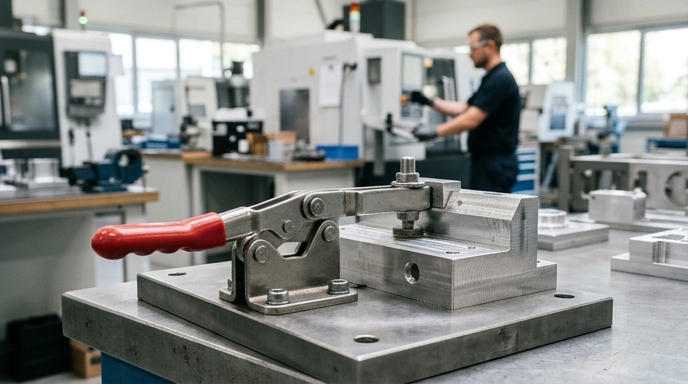
Holding Capacity vs. Clamping Force — Why Catalogs Blur the Line
Holding capacity is the load the clamp resists. Clamping force is the load the clamp applies. The two numbers can differ by a factor of two or more, and manufacturers tend to print the bigger one in large font, which leads fixture designers to overestimate what’s actually squeezing their part.
Holding capacity represents the maximum static force the clamp can withstand after closing without permanent deformation to the linkage. Destaco defines this as the mechanical limit of the over-center lock. If a workpiece pushes back against the spindle with a force exceeding the holding capacity, the clamp will yield, bend, or pop open — pick your failure mode.
Clamping force (often called exerting force) is the actual pressure the spindle applies when the operator closes the handle. Destaco notes exerting force is typically only 1/3 to 1/2 of the stated holding capacity. An operator pulling a handle with 40 lbs of input force might generate 200 lbs of clamping force even if the clamp has a 600 lb holding capacity on the sticker.
| Term | Definition | Typical Value Ratio |
|---|---|---|
| Holding Capacity | Max static load resisted before failure/opening. | 100% (the published spec) |
| Clamping Force | Active force applied to the workpiece by the spindle. | 33% to 50% of holding capacity |
| Input Force | Manual force applied by the operator to the handle. | 5% to 10% of holding capacity |
Rated Capacity by Clamp Style — What the Numbers Actually Mean
Different clamp geometries distribute loads differently across their pivot pins. A 500 lb rating on a horizontal clamp doesn’t behave quite the same as a 500 lb rating on a latch-action clamp. Capacity is measured at the closest possible spindle position to the handle — move the spindle outward and that number starts bleeding immediately.
Horizontal and vertical handle clamps use a solid or U-shaped hold-down bar. The Destaco 225-U horizontal clamp carries a 500 lbf holding capacity; the vertical 2002-U rates at 600 lbf. Both ratings assume the spindle sits at the innermost position on the U-bar.
Push-pull clamps drive a plunger straight forward. The Good Hand GH-302-F push-pull model rates at 300 lbs (136 kg). Because the load travels axially into the linkage rather than acting on a lever arm, push-pull clamps tend to achieve higher holding capacities for their physical footprint.
Latch-action clamps pull two components together, which is why you find them on mold closures and pressure vessels. The Carr Lane CL-250-PA latch clamp offers a 2,000 lb holding capacity. Pneumatic versions like the Destaco 810-S mirror the linkage of manual clamps and offer identical holding capacities (600 lbf), though their active clamping force depends entirely on cylinder pressure.
The Spindle Lever-Arm Effect (The Derating Nobody Talks About)
Extending a toggle clamp spindle by 25 mm can cut holding capacity in half, because the pivot now sees a larger moment arm. Published capacities assume the spindle is mounted at the base of the clamp arm. Move it, and the physics of your fixture changes whether the catalog mentions it or not.
The math is nothing exotic: Moment = Force × Distance. If a clamp rates at 600 lbf with the spindle 1 inch from the pivot, the linkage is designed to withstand a 600 in-lb moment. Push the spindle out to 3 inches and the maximum allowable force at the tip drops to 200 lbf to stay under that same 600 in-lb limit.
Raising spindle height with long extensions also introduces a secondary moment arm. A tall spindle acts as a vertical lever, applying a twisting force to the U-bar, and that torsional load accelerates wear on the pivot pins. You’ll see the clamp arm start to deflect sideways under heavy cuts before anything actually breaks, which is usually your warning.
How Mounting, Bolts, and Base Rigidity Change Real-World Capacity
A 1,000 lb toggle clamp bolted to a 1/8-inch aluminum plate will fail long before it reaches its rated capacity. Published holding capacity assumes a perfectly rigid mounting surface. If the base plate flexes, the over-center linkage geometry changes, and the clamp releases prematurely.
Mounting hardware limits capacity directly. A standard 1/4-20 Grade 8 bolt wants 12 ft-lbs of torque. Use low-grade hardware or under-torque the bolts, and the clamp base shifts under load. A shift of just 0.020 inches can pull the linkage out of its locked over-center position, which is a terrifyingly small number when you think about it.
- Base plate thickness: minimum 3/8-inch steel or 1/2-inch aluminum for anything rated over 500 lbf.
- Specify Grade 8, or Metric Class 10.9, socket head cap screws. Don’t cheap out here.
- Avoid mounting on heavily painted or uneven surfaces — the paint compresses under load, the bolts loosen, and three weeks later you’re wondering why the fixture drifted.
Static Ratings in a Dynamic World — Vibration, Cutting Loads, and Fatigue
Published numbers are static. Real applications involve impact, vibration, and cyclic reversals. A toggle clamp holding a part for CMM inspection sees purely static loads. A toggle clamp holding a steel bracket during an aggressive face-milling operation experiences something else entirely, and that something else is what the catalog doesn’t model.
Machinists on the Practical Machinist forums regularly report manual toggle clamps popping open during heavy interrupted cuts. The mechanism is straightforward: vibration travels through the workpiece into the spindle and effectively bounces the linkage out of its locked state, one tiny micro-displacement at a time, until the over-center geometry gives up. Static holding capacity ratings do not account for this. They can’t — vibration is a property of your setup, not the clamp.
To combat dynamic failure, manufacturers offer secondary locking mechanisms. Destaco’s Toggle Lock Plus adds a secondary release lever that physically blocks the main linkage from opening, even if vibration knocks the primary over-center lock loose. For heavy milling, I’d generally skip the manual toggles and go straight to mechanical locks or hydraulic workholding. I know plenty of shops that get away with plain manual clamps on steel milling by just over-sizing them 4x, and honestly that works most of the time — old habit on my end, not strictly justified by the spec sheet.
Choosing a Safety Factor That Won’t Bite You
Fixture engineers typically apply a 2x safety factor for static workholding and 3x to 4x for dynamic or operator-adjacent setups. Sizing a clamp exactly to its published limit is how you guarantee a failure within the first production run.
The safety factor is there to absorb operator fatigue, part tolerance variation, and linkage wear. A tired operator doesn’t push the handle fully into lock. A cast iron part running 0.030 inches oversize forces the clamp to absorb stresses it was never spec’d for.
| Application Type | Recommended Safety Factor | Example Scenario |
|---|---|---|
| Static / Light Duty | 1.5x to 2.0x | CMM inspection fixtures, light gluing jigs. |
| Medium Dynamic | 2.0x to 3.0x | Drilling, light aluminum routing, welding fixtures. |
| Heavy Dynamic | 3.0x to 4.0x | Steel milling, heavy vibration, operator-adjacent setups. |
Pneumatic & Hydraulic Ratings — Why They Don’t Scale Linearly from Manual
Pneumatic toggle clamps rate their exerting force at a specific line pressure, usually 5 bar (72 psi). Drop below that and the clamping force falls non-linearly, because the toggle linkage’s mechanical advantage curve is itself non-linear.
A pneumatic cylinder’s force equals pressure times piston area. The Destaco 810-S uses a cylinder to drive the same mechanical linkage you’d find in a manual version. At 72 psi, the cylinder generates enough force to push the linkage over-center and apply its rated clamping force.
Drop shop air to 50 psi and the cylinder produces less linear force. Because the toggle linkage multiplies force exponentially as it approaches the over-center point, a roughly 30% drop in air pressure can translate into something like a 50% drop in final clamping force — ballpark, and it varies with cylinder bore and linkage geometry, so don’t quote me on the exact ratio for your specific clamp. The holding capacity remains 600 lbf once it’s locked. The problem is getting it locked in the first place.
Failure Modes and Field-Diagnosing a Weak Clamp
Beyond the clamp simply popping open, failure modes include bolt pull-out, bent spindles, worn pivot pins, and compressed rubber tips. Inspect any used clamp before you trust its published rating in a new fixture.
Rubber tip compression set is the one that catches people out. Standard neoprene spindle tips run around 70A durometer, and under sustained high-load cycles the rubber permanently flattens. Users on r/Machinists have noted this compression set reduces the effective reach of the spindle, so the clamp holds the part loosely even when fully locked over-center — the handle snaps, everything looks right, and the part still shifts under cut. The fix is a $4 replacement tip. The diagnosis is what takes an afternoon.
Pre-use inspection checklist:
- Check pivot pins for side-to-side play.
- Verify the U-bar is straight. A bent bar means the clamp has already seen loads above its holding capacity at some point, and you can’t un-bend it back to spec.
- Inspect the rubber spindle tip for flattening or cracking.
- The handle should snap firmly into the over-center position. If it feels mushy, something in the linkage is worn.
FAQ
How much weight can a toggle clamp hold?
Holding capacities range from 100 lbs for miniature instrument clamps to over 7,500 lbs for heavy-duty forged latch clamps. Standard horizontal and vertical clamps used in welding and machining typically hold between 200 lbs and 1,000 lbs.
What’s the difference between holding capacity and clamping force?
Holding capacity is the maximum static load the clamp can resist before breaking or opening. Clamping force is the active pressure the clamp applies to the workpiece, generally 1/3 to 1/2 of the holding capacity. The catalog number you see is almost always the former.
What safety factor should I use when sizing a toggle clamp?
2x for static loads, 3x to 4x for dynamic.
Why does my pneumatic toggle clamp feel weaker than its rating?
Pneumatic clamps need a specific line pressure, usually 72 psi / 5 bar, to hit their rated exerting force. If your shop air fluctuates or drops below that, the cylinder can’t push the linkage fully over-center, and you get a weak grip even though the clamp itself is fine. Check your regulator before you blame the hardware. Nine times out of ten on a shared air line with a big machine on the same circuit, that’s where the problem lives — and if you’ve got a long run of undersized tubing between the regulator and the clamp manifold, the pressure drop under flow can be worse than what the gauge at the wall tells you.
