
TL;DR: De-Sta-Co wins on global availability and pneumatic integration. Carr Lane wins on USA-made consistency and a catalog that doesn’t require decoder rings. Both lose to Good Hand if you’re outfitting low-cycle budget fixtures. In a direct comparison, a Destaco 207-U runs about $28 and the equivalent Carr Lane CL-500-HTC is around $31, but they share the same 5/16-18 spindle thread and the same 1.25″ x 1.00″ mounting pattern, which is really what matters when you’re staring at a worn-out clamp on a Friday afternoon.
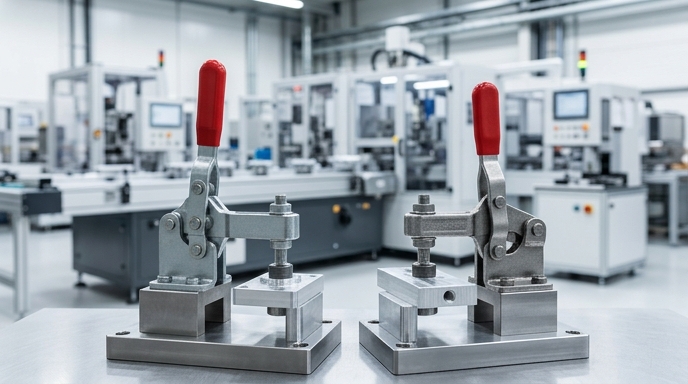
The Short Answer: Which Clamp Wins for Your Scenario
Right clamp depends on duty cycle and environment. That’s the whole game.
- High-cycle automated production: De-Sta-Co. Toggle Lock Plus and the 800-series pneumatics own the automated-cell market.
- Heavy-duty welding fixtures: Carr Lane. Solid-bar models hold up better against weld spatter than standard U-bars.
- Prototyping and budget MRO: Good Hand. Around $12 a clamp, Taiwanese import, perfectly fine for anything under 1,000 cycles.
- Strict “Made in USA” requirements: Carr Lane, since St. Louis production is tighter and more consistent across their core manual line.
| Application Scenario | Winner | Primary Reason |
|---|---|---|
| High-Cycle CNC Workholding | De-Sta-Co | Hardened bushings and Toggle Lock Plus options |
| Welding & Fabrication | Carr Lane | Solid bar availability and spatter resistance |
| Pneumatic Integration | De-Sta-Co | Massive 800-series pneumatic catalog |
| Low-Cycle / Budget | Good Hand | 60% lower cost than premium brands |
Catalog Depth and Model Range in 2026
Ownership changed recently. Stabilus closed its acquisition of De-Sta-Co from Dover for $680 million back in April 2024. The catalog hasn’t visibly changed yet, and De-Sta-Co still runs the broadest manual-clamp lineup in the industry (north of 500 active SKUs by my count) with a heavy pneumatic and hydraulic bias.
Carr Lane is still family-owned, St. Louis-based, and keeps a tighter focus on core workholding and fixture components. Specifying from them is just faster for most manual applications. Their part numbers literally tell you the capacity — CL-500-HTC holds 500 lbs. De-Sta-Co uses legacy series numbers like 207-U that mean 375 lbs, which you’d never guess without the datasheet open. I’ve been reading these for two decades and I still pull up the PDF to double-check.
| Action Type | De-Sta-Co Strength | Carr Lane Strength |
|---|---|---|
| Horizontal Hold-Down | Massive variety of base styles | Clear capacity-based naming |
| Vertical Hold-Down | Toggle Lock Plus safety catches | Heavy-duty solid bar options |
| Push-Pull (Plunger) | High-capacity forged models | Compact footprint designs |
| Pneumatic | Industry standard (807-U series) | Basic drop-in replacements |
Head-to-Head on Holding Force and Dimensions
Horizontal hold-down, straight comparison: De-Sta-Co 207-U gives you 375 lbs, Carr Lane’s equivalent CL-500-HTC gives you 500 lbs. Both are measured at the point closest to the pivot, which is the usual industry convention, and the applied force drops off hard as you move the spindle out toward the end of the U-bar. Anyone who’s actually loaded a part knows this; the published numbers are best-case.
Here are three common horizontal hold-down equivalents side by side, since this is what people actually need when they’re cross-referencing for a fixture rebuild.
| Spec | De-Sta-Co 202-U | Carr Lane CL-250-HTC | De-Sta-Co 207-U | Carr Lane CL-500-HTC |
|---|---|---|---|---|
| Holding Capacity | 200 lbs | 250 lbs | 375 lbs | 500 lbs |
| Spindle Thread | 1/4-20 | 1/4-20 | 5/16-18 | 5/16-18 |
| Mounting Pattern | 1.00″ x 1.00″ | 1.00″ x 1.00″ | 1.25″ x 1.00″ | 1.25″ x 1.00″ |
| Bar Style | U-Bar | U-Bar | U-Bar | U-Bar |
The 207-U and the CL-500-HTC share the industry-standard 1.25″ x 1.00″ flanged base pattern. Practically, that means you can unbolt a dead De-Sta-Co and drop a Carr Lane onto the same fixture plate. No new holes, no re-doweling.
Build Quality and Failure Modes in High-Cycle Use
Premium brand marketing loves to throw around million-cycle lifespan numbers. Field data doesn’t back that up. From what I’ve seen on Practical Machinist threads and in my own shops over the years, standard manual toggle clamps from both brands typically give up somewhere between 100,000 and 250,000 cycles in real-world machining environments. Anecdotally, in a dirty cast-iron environment you can be at the low end of that.
Failure modes are the same across both brands. The pivot pin goes first. Cast iron dust, abrasive coolant, no seal — the pin galls, wears down, and introduces slop into the handle. Once there’s lateral play in the handle, the over-center geometry stops positively engaging, and the clamp pops open under vibration. That’s your warning that the whole clamp is going to the scrap bucket, because nobody sells replacement pivot pins, which I’ll come back to.
Secondary failure: neoprene spindle tips degrading. Synthetic coolants eat the rubber inside 12 to 18 months of continuous exposure. Both brands sell stainless hex-head spindles as the fix. Spec those from day one if you’re running synthetics.
Spindle, Accessory, and Retrofit Interchangeability
Most comparisons skip this, which is weird because this is the part that actually drives MRO purchasing decisions. You can thread a De-Sta-Co spindle into a Carr Lane clamp as long as you match the size class.
The industry’s been standardized on thread pitch by capacity tier for a long time:
- 200-250 lb class (Destaco 202-U / Carr Lane CL-250-HTC): 1/4-20
- 375-500 lb class (Destaco 207-U / Carr Lane CL-500-HTC): 5/16-18
- 600-750 lb class (Destaco 210-U / Carr Lane CL-750-HTC): 3/8-16
Flanged washers, neoprene flat-tip spindles, swivel-foot pads — all interchangeable between the two brands inside the same thread class. If a CL-500-HTC loses its rubber pad, a maintenance tech can thread a De-Sta-Co 225208-M spindle assembly right into the Carr Lane U-bar and move on with their day.
2026 Pricing, Tariffs, and Where Each Is Actually Made
As of 2026, De-Sta-Co runs roughly 10% cheaper on equivalent manual models through major distributors. Global manufacturing footprint is doing that work. Post-Stabilus, De-Sta-Co is still manufacturing across the USA, Germany, and Thailand.
Carr Lane makes the bulk of its toggle clamps in St. Louis. That insulates them from Section 301 tariffs on imported steel, but it means a higher baseline price. Fair trade-off if your customer requires domestic sourcing documentation, which is a non-trivial slice of defense and aerospace work.
| Model | 2026 Estimated Price | Typical Origin |
|---|---|---|
| De-Sta-Co 207-U | $28.45 | Global / Thailand |
| Carr Lane CL-500-HTC | $31.20 | USA |
| De-Sta-Co 210-U | $36.50 | Global / Thailand |
| Carr Lane CL-750-HTC | $41.00 | USA |
Prices based on single-unit MAP from MSC Industrial and Carr Lane direct, ballpark Q1 2026. Expect drift.
Lead Time, Distribution, and Serviceability
A $28 clamp with a six-week lead time shuts down a line exactly as hard as a broken spindle. De-Sta-Co has a real edge on distribution depth. MSC, Grainger, and McMaster all stock thousands of De-Sta-Co units across regional warehouses, so next-day to most US shops is routine.
Carr Lane runs more on direct sales and specialized distributors. They hold deep inventory at the Missouri facility, but if you’re buying through a punch-out procurement system tied to Grainger, you’re going to find De-Sta-Co faster, every time.
Both brands sell replacement handle grips, flanged washers, and spindle assemblies. Neither sells replacement pivot pins. Frame wears out, clamp goes in the scrap bin. I still don’t understand why this is the industry norm.
When Neither Brand Is the Right Answer
Defaulting to De-Sta-Co or Carr Lane burns money in specific scenarios, and I say this as someone who still specs De-Sta-Co for freshwater builds, I mean, for low-cycle welding jigs, out of pure habit I know isn’t justified.
For Low-Cycle Budget Fixtures: Good Hand. Taiwanese, the GH-225-D is dimensionally equivalent to the 207-U and CL-500-HTC. About $12 on Zoro or Amazon. For a welding fixture that gets used twice a month, spending $31 on a Carr Lane buys you nothing you can measure.
For Variable Part Sizes: Bessey. The STC-IHH25 self-adjusts for material thickness variation up to 5/8″ while holding consistent clamping force. Neither De-Sta-Co nor Carr Lane has a mechanical self-adjusting feature that actually works this well, which makes Bessey the default pick for woodworking and any variable-stock fab job.
For Premium US-Made Alternatives: Jergens, out of Cleveland. Direct competitor to Carr Lane for strict domestic-sourcing contracts. Worth a quote if you’re already fighting over tariff pass-throughs.
FAQ
Is Carr Lane or De-Sta-Co made in the USA?
Carr Lane manufactures most of its toggle clamps in St. Louis. De-Sta-Co manufactures globally — USA, Germany, Thailand — so a given De-Sta-Co part may or may not be imported depending on the SKU and the production run. If domestic sourcing matters for your contract, ask for a country-of-origin letter on the specific part number before you buy. The sales rep can usually pull it within a day, and it’s cheaper than finding out at receiving inspection that the box says Thailand.
Can I substitute Carr Lane clamps for De-Sta-Co in an existing fixture?
Yes. Equivalent models (De-Sta-Co 207-U and Carr Lane CL-500-HTC, for example) share identical 1.25″ x 1.00″ base hole patterns and the same 5/16-18 spindle threads. Drop-in.
Which brand has better pneumatic toggle clamps?
De-Sta-Co. The 800-series (807-U and friends) is the industry standard for automated welding cells and robotic CNC loading.
What’s the cheapest reliable alternative to both brands?
Good Hand. Roughly 60% less than De-Sta-Co or Carr Lane and perfectly adequate for low-cycle or prototyping work.
