
TL;DR: Sourcing toggle clamps from China under OEM means finding an actual manufacturer (usually Dongguan or Ningbo), negotiating MOQs around 500–1,000 units for stock models or 2,000+ if you need custom tooling. Spec HRC 40-45 hardness in your QC checks, budget 45–75 days of lead time, and add 30% on top for import duty under HTS 8205.70.0090.
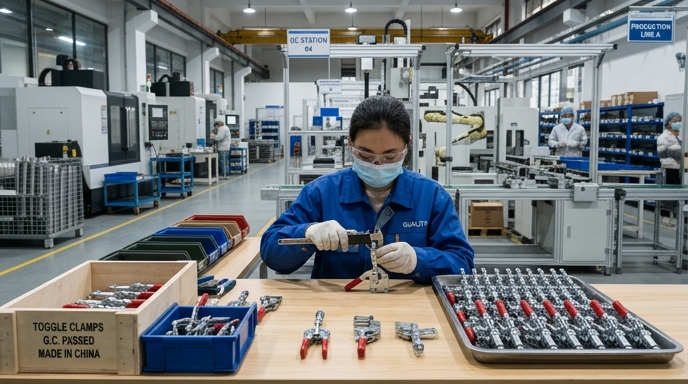
Why Toggle Clamp Sourcing Breaks the Standard “China Playbook”
Generic hardware sourcing usually means messaging three Alibaba suppliers and picking the one in the middle. That approach falls apart with toggle clamps because they’re hybrid assemblies. A standard horizontal clamp needs cold-rolled steel stamping, pivot pin machining, PVC handle dip-molding, and manual assembly, which is four distinct capabilities most “factories” on B2B platforms don’t actually have under one roof.
Which is why 60-70% of toggle clamp listings on B2B platforms belong to trading companies, not factories. Traders buy generic, untested assemblies from sub-tier workshops and apply heavy markups. The quality fade shows up in the pivot pins and spindle threads first, which are also the parts that take the most mechanical stress. Not a coincidence.
Trader vs. Factory — 5 Instant Tells
- Catalog focus. A real factory lists exclusively GH-series, CH-series, or custom clamps. A trader lists clamps alongside drill bits, zip ties, and safety goggles.
- ISO certification. Factories hold ISO 9001:2015 for metal stamping or forging. Traders hold ISO 9001 for “sales and trading,” which tells you everything.
- Registered capital. Real stamping facilities need serious capex. Look for registered capital above 5,000,000 RMB on the business license.
- Location. Downtown Shenzhen office tower? Trader. Industrial park in Dongguan or Ningbo? Possibly a factory.
- Tooling capability. Ask for a quote on a custom forging die. Factories come back with $3,000–$8,000 and a 30-day lead time. Traders either refuse or quote absurd numbers to make you go away.
Mapping China’s Toggle Clamp Manufacturing Clusters
China’s toggle clamp production is concentrated in three clusters. Source from the wrong one and you’re paying a middleman by default, even if the quote comes directly from the “factory.”
Dongguan in Guangdong province dominates stamped metal. Factories there, Dongguan Clamptek Enterprise Co., Ltd being one of the better-known names, use SPCC cold-rolled carbon steel to stamp high-volume, light-to-medium duty clamps. If you need a 500-lb horizontal hold-down for jig work, this is where it comes from.
Ningbo and Wenzhou in Zhejiang handle heavy-duty forging. 45# steel forged bases rated for 2,000 lbs of holding force are a Zhejiang specialty, and frankly, trying to buy a forged clamp from a Dongguan stamper is how people end up with cracked bases three months in.
Qingdao in Shandong serves the heavy industrial and pneumatic market. Factories in the northern cluster integrate pneumatic cylinders with toggle mechanisms for automated welding fixtures. It’s a smaller segment but the only place to go if you’re building something that gets actuated by a PLC.
Cluster Comparison
| Cluster | Specialty | Price Band | Lead Time | Export Port |
|---|---|---|---|---|
| Dongguan (Guangdong) | Stamped SPCC, light/medium duty | Low ($0.50 – $2.00) | 30-45 days | Shenzhen / Guangzhou |
| Ningbo/Wenzhou (Zhejiang) | Forged 45# steel, heavy duty | Medium ($2.00 – $8.00) | 45-60 days | Ningbo / Shanghai |
| Qingdao (Shandong) | Pneumatic, hydraulic, automated | High ($15.00 – $50.00) | 60-75 days | Qingdao |
Decoding OEM vs. ODM vs. Stock-with-Logo for Clamps
Buyers ask for “OEM” when what they actually need is a stock product with their logo on it. Understanding the three tiers prevents spending $8,000 on tooling you didn’t need.
Tier 1: Stock Clamp with Custom Branding
You take a factory’s existing model, GH-225-D for example, and laser-engrave your logo on the handle arm. Factory also packages it in a printed polybag or box.
- MOQ: 500 to 1,000 units.
- Tooling cost: $0.
- Best for: Amazon sellers and regional distributors.
Tier 2: Modified Stock (ODM)
Same stamping dies, but you request a custom PVC handle color (red is standard; blue or black are the usual asks) and sometimes a different spindle type, swapping a nylon flat-tip for a hex-head steel spindle for instance.
- MOQ: 1,000 to 2,000 units.
- Tooling cost: $0 to $200 for custom handle dip molds.
- Best for: Brands that need to look different without taking mechanical risk.
Tier 3: Full Custom Tooling (OEM)
You hand over proprietary CAD for a clamp geometry that doesn’t exist in the market. Factory cuts new progressive stamping dies or forging molds.
- MOQ: 2,000+ units.
- Tooling cost: $3,000 to $8,000 for stamped dies; up to $15,000 for complex forged molds.
- Best for: Jig and fixture manufacturers building proprietary automated assembly lines.
Reading a Chinese Toggle Clamp Spec Sheet Without Getting Burned
Chinese catalogs universally cross-reference American De-Sta-Co model numbers. The De-Sta-Co 225-U, a horizontal hold-down with a 500 lb capacity, translates directly to the Chinese GH-225-D. The “GH” prefix comes from Good Hand, a legacy Taiwanese manufacturer whose naming convention got absorbed by mainland factories years ago. Obviously if you’re sourcing a GH-series clamp you know not to accept a Chinese factory telling you their “GH” is identical to the Taiwanese original without seeing a sample.
When you’re reviewing a spec sheet, verify dimensional equivalence instead of accepting “visually similar.” The common failure anecdotally reported by r/manufacturing users is cheap clones reducing the pivot pin diameter from 6mm to 5mm to save steel. That little millimeter is the difference between a clamp that lasts five years and one that shears pins after a few hundred cycles under load.
Critical Spec Sheet Checkpoints
- Holding capacity. Rating should match your requirement (227 kg for a 500 lb equivalent).
- Base plate hole pattern. Chinese domestic clamps default to metric spacing. If you’re retrofitting American fixtures, specify imperial, in writing, on the PO.
- Material grade. Sheet must specify SPCC for stamped parts or 45# steel for forged. If it just says “carbon steel,” reject it.
- Spindle thread. Confirm M8 metric or 5/16-18 imperial.
The QC Protocol That Separates Pros from Burned Importers
A proper toggle clamp QC protocol has four specific mechanical tests. Generic AQL visual inspections don’t catch metallurgical defects, which is where clamps actually fail. Write these four tests into your PO and hire a third-party inspector. QIMA runs about $309 per man-day in China, which is cheap insurance compared to a container of soft-pin clamps.
Pre-Shipment Inspection Scope for Toggle Clamps
- Holding force dynamometer test. Mount the clamp to a steel jig, apply upward force against the spindle with a dynamometer. A 500 lb-rated clamp must hold 227 kg without the locking mechanism slipping.
- Spindle and pin Rockwell hardness. Carbon steel spindles and pivot pins have to be heat treated. A portable hardness tester verifies HRC 40-45. Untreated pins come in around HRC 20 and deform after maybe a hundred uses.
- Cycle fatigue test. Actuate the handle 10,000 times on a pneumatic rig. Inspect the pivot rivets for play or metal shaving dust.
- Handle deflection. Apply 150% of rated load and measure the handle lever. Permanent bending means the SPCC gauge is under-spec.
I still spec the full dynamometer test even on reorders from factories I’ve used for years. Old habit from getting burned once, probably overkill for a trusted supplier, but it costs $309 and it keeps everyone honest.
Pricing Reality — What Toggle Clamps Should Actually Cost FOB
Pricing moves with clamp type, material, and volume. The bands below are realistic FOB Ningbo or Shenzhen prices for standard quality as of early 2025. Quotes below these numbers almost always mean skipped heat treatment or thinned steel gauges, and occasionally both.
| Clamp Type | Benchmark Model | 500 Units | 2,000 Units | 10,000 Units |
|---|---|---|---|---|
| Horizontal (Stamped) | GH-225-D (500 lbs) | $1.15 | $0.95 | $0.85 |
| Vertical (Stamped) | GH-12130 (500 lbs) | $1.30 | $1.10 | $0.95 |
| Push-Pull (Forged) | GH-36003 (600 lbs) | $2.50 | $2.25 | $2.10 |
| Latch (Heavy Duty) | GH-40341 (2000 lbs) | $8.50 | $7.80 | $7.20 |
Hidden costs to budget: custom printed packaging ($0.10 to $0.30 per unit), third-party inspection (~$309 per order), and replacement spindles if you upgrade from nylon tips to swivel-foot steel pads ($0.20 to $0.50 per unit).
Landing Cost Math — Tariffs, Shipping, and the Section 301 Reality
Toggle clamps imported to the U.S. fall under HTS 8205.70.0090, which covers hand tools, vises, clamps and parts thereof. Landed cost math is standard duty, Section 301 tariff, and ocean freight on top.
The current MFN duty rate for 8205.70.0090 is 5%. Toggle clamps from China are also hit with the 25% Section 301 tariff, so your total import duty is 30%.
Worked Example: 2,000 Units of GH-225-D
- FOB price: 2,000 units @ $0.95 = $1,900
- Ocean freight (LCL to LAX): $450
- Customs value: $1,900
- Total duty (30%): $570
- Merchandise Processing Fee (MPF): $31.67 minimum
- Harbor Maintenance Fee (HMF): $2.38
- Total landed cost (DDP U.S. warehouse): $2,954.05
So a clamp that costs $0.95 at the Chinese factory lands at $1.47 per unit in your warehouse. Which is still cheaper than any domestic equivalent, but the margin is thinner than new importers assume once you’ve paid the duty and the freight forwarder.
Protecting Your Brand and IP in a Copy-Friendly Ecosystem
A standard toggle clamp mechanism is decades old and impossible to patent. Your brand name, custom packaging, and proprietary CAD modifications are a different story.
Don’t rely on U.S. trademarks to protect your brand in China. China runs a first-to-file trademark system. Register your brand directly with the China National Intellectual Property Administration (CNIPA) before placing your first order. Ballpark $150 to $300, 9 to 12 months to clear. If a factory registers your brand first, they can legally seize your goods at the Chinese port before export, and I’ve watched exactly that happen to a buyer who thought his Delaware LLC trademark meant something in Guangdong.
Before sharing proprietary CAD for a Tier 3 OEM project, execute an NNN (Non-Disclosure, Non-Use, Non-Circumvention) drafted by a Chinese lawyer. Standard Western NDAs are not enforceable in Chinese courts. An NNN is what stops the factory from using your custom forging dies to sell your exact clamp to your competitor six months later.
The 90-Day Execution Timeline from First Inquiry to Container Loading
Sourcing toggle clamps isn’t an overnight thing. Budget 90 days from first Alibaba message to container loading at the port.
- Weeks 1–2 (supplier shortlist). Vet 10 suppliers. Eliminate traders by catalog scope and location. Narrow to 3 factories.
- Weeks 3–5 (samples). Pay $50–$100 for air-freighted samples from the shortlist. Test holding force and spindle hardness in-house.
- Week 6 (negotiation and PO). Pick the winner. Draft a PO specifying HRC 40-45 hardness and HTS 8205.70.0090 compliance. Pay the 30% T/T deposit.
- Weeks 7–11 (production). Standard lead for 2,000 to 5,000 units is 30 to 35 days. Add 15 if custom dies.
- Week 12 (inspection). QIMA or similar runs the dynamometer and fatigue tests.
- Week 13+ (shipping). Approve the report, pay the 70% balance, load FOB Ningbo or Shenzhen.
FAQ
What’s the minimum order quantity for OEM toggle clamps from China?
500 to 1,000 units for stock clamps with laser-engraved logos (Tier 1). 1,000 to 2,000 for custom handle colors (Tier 2). 2,000+ for fully custom tooling (Tier 3).
Are Chinese toggle clamps compatible with De-Sta-Co fixtures?
Mostly yes. Chinese factories produce direct dimensional equivalents to De-Sta-Co models, so for example the De-Sta-Co 225-U maps to the Chinese GH-225-D on all the critical dimensions. The one place this falls apart is the base plate hole pattern, because a lot of Chinese domestic clamps default to metric spacing while U.S. fixtures are usually drilled imperial. If you’re retrofitting into existing American jigs, you have to specify imperial hole spacing explicitly on the PO, otherwise the factory ships what their stock tooling produces and you end up re-drilling 2,000 clamps in your receiving department. Which I’ve seen happen.
What HTS code and tariff applies to toggle clamps imported to the U.S.?
HTS 8205.70.0090. 5% MFN duty, 25% Section 301, 30% total.
How do I verify a toggle clamp factory isn’t actually a trading company?
Business license should show registered capital above 5,000,000 RMB and ISO 9001:2015 scoped to “metal stamping” or “forging” rather than “sales and trading.” Address should be an industrial park in Dongguan or Ningbo, not a downtown office tower.
What’s a realistic sample cost and lead time for custom toggle clamps?
Stock clamp with your logo: $50 to $100 (mostly DHL/FedEx), 7 to 10 days. Custom forged clamp with new dies: $3,000 to $8,000 for sample tooling, 30 to 45 days before the physical sample ships.
Can I get CE or RoHS certification for toggle clamps from China?
Toggle clamps are purely mechanical, so no CE needed for the EU market. If your clamps use PVC handle grips or rubber spindle caps, request RoHS compliance to confirm the plastics are free of restricted heavy metals.
